
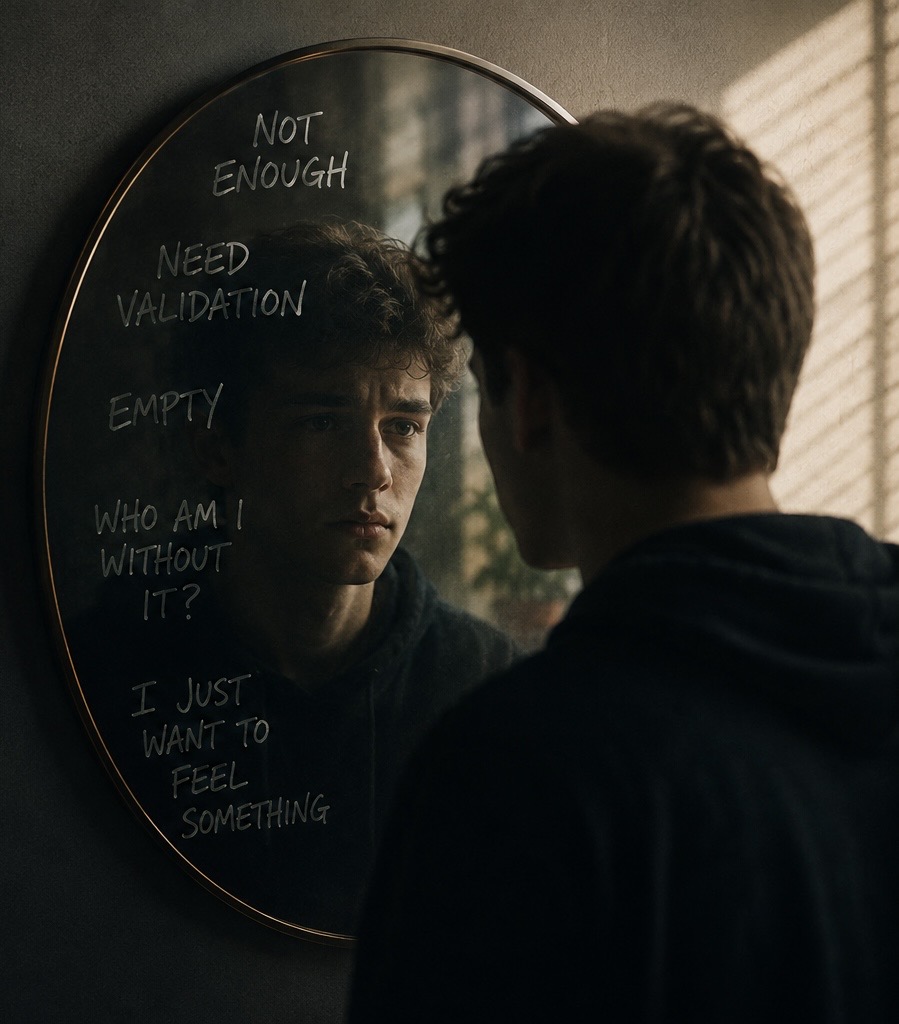
There’s something nobody talks about when it comes to sexual sin and recovery — the emotion underneath it isn’t always lust.
For me, a lot of the time, it was insignificance.
I didn’t always know that. I thought I just had a bad habit. I thought I kept coming back to the same thing because I was weak, or undisciplined, or just not trying hard enough. That’s what shame told me. And shame is a convincing liar.
But when I started actually tracing the pattern — when did it happen, what was going on before it, what was I feeling — a clearer picture came up. It usually wasn’t after a great day. It was after a day where I felt like I didn’t matter. Where my finances reminded me I wasn’t providing the way I wanted to. Where I felt like I wasn’t trusted, or reliable, or enough.
I wasn’t looking for sexual content. I was looking for proof that I existed. That I mattered to something.
The screen gave me that. Fake, hollow, temporary — but it gave me something that felt like significance. And I kept going back because it worked, in the most shallow sense of the word.
Here’s what I’ve had to sit with: I taught my brain that screen intimacy was real intimacy. And in doing that, I started pulling away from the real thing. Deep conversations with people I loved. Real presence with my kids. I chose the screen because the screen didn’t ask anything of me — and real relationships do.
That’s not an excuse. It’s a map. And maps are useful because they show you where you actually are, not where you wish you were.
The work, for me, has been learning to interrupt the pattern before it completes. When that feeling of insignificance shows up — and it still shows up — I have to do something different with it than I used to. I’ve been learning to declare something true over myself instead of letting shame define the moment. Not a motivational speech. Just something real: I am a good father. I have been called to something here. God isn’t finished with what He started.
That sounds simple. It is not easy.
But here’s what I’ve found: the lie of insignificance loses power when it gets spoken back to directly. Not ignored. Not shamed. Answered.
If any of this sounds familiar — if you’ve ever found yourself reaching for something you didn’t really want because you were running from a feeling you couldn’t name — you’re not alone in that. And the way out isn’t more willpower. It’s more honesty about what’s actually going on underneath.
That’s where the real work starts.
Leave a Reply